Reading the astigmatism axis
If your prescription has astigmatism, each eye gets two more numbers after the sphere: a cylinder for how strong it is, and an axis for the direction it runs in.
Astigmatism blurs one way more than the other.
A typical cornea curves evenly, like a ball. An astigmatic one curves more in one direction than the other, more like the back of a spoon, so light crossing the steep curve focuses somewhere different from light crossing the flat one. Your eye can’t bring both to a point at once, so lines running one way look sharp while lines across them smear.
Almost everyone has a little astigmatism. Under about −0.75 most people never notice it, and an optometrist may not bother correcting it.
The cylinder tells you how strong it is.
Cylinder, written CYL, is the extra power in dioptres. You’d barely notice a −0.50 cylinder, while at −3.00 street signs start to streak. On a card it comes right after the sphere, with the axis after a ×, so −1.25 −1.00 × 180 means a sphere of −1.25 and a cylinder of −1.00 at an axis of 180.
The axis tells you which way it runs.
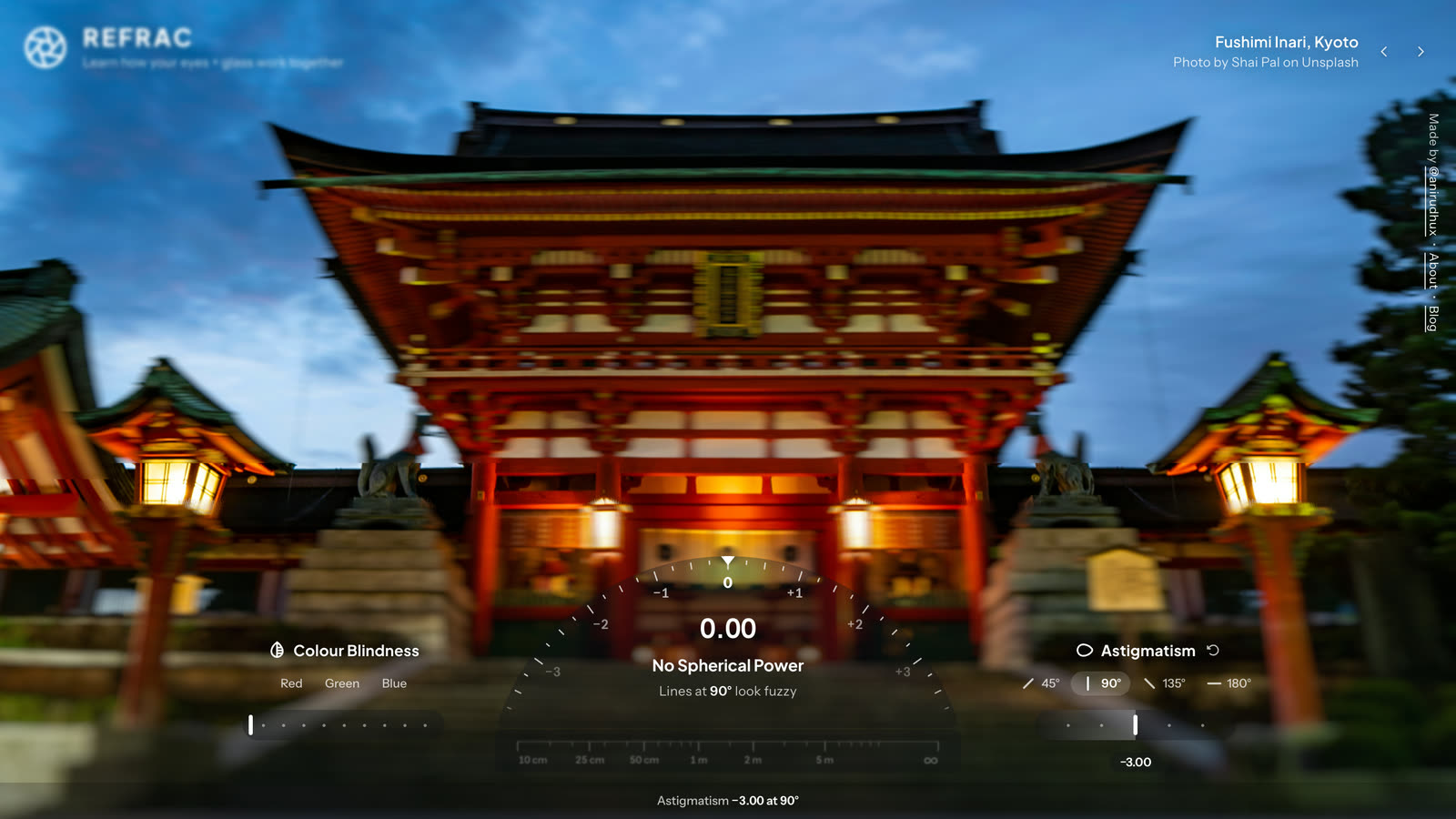
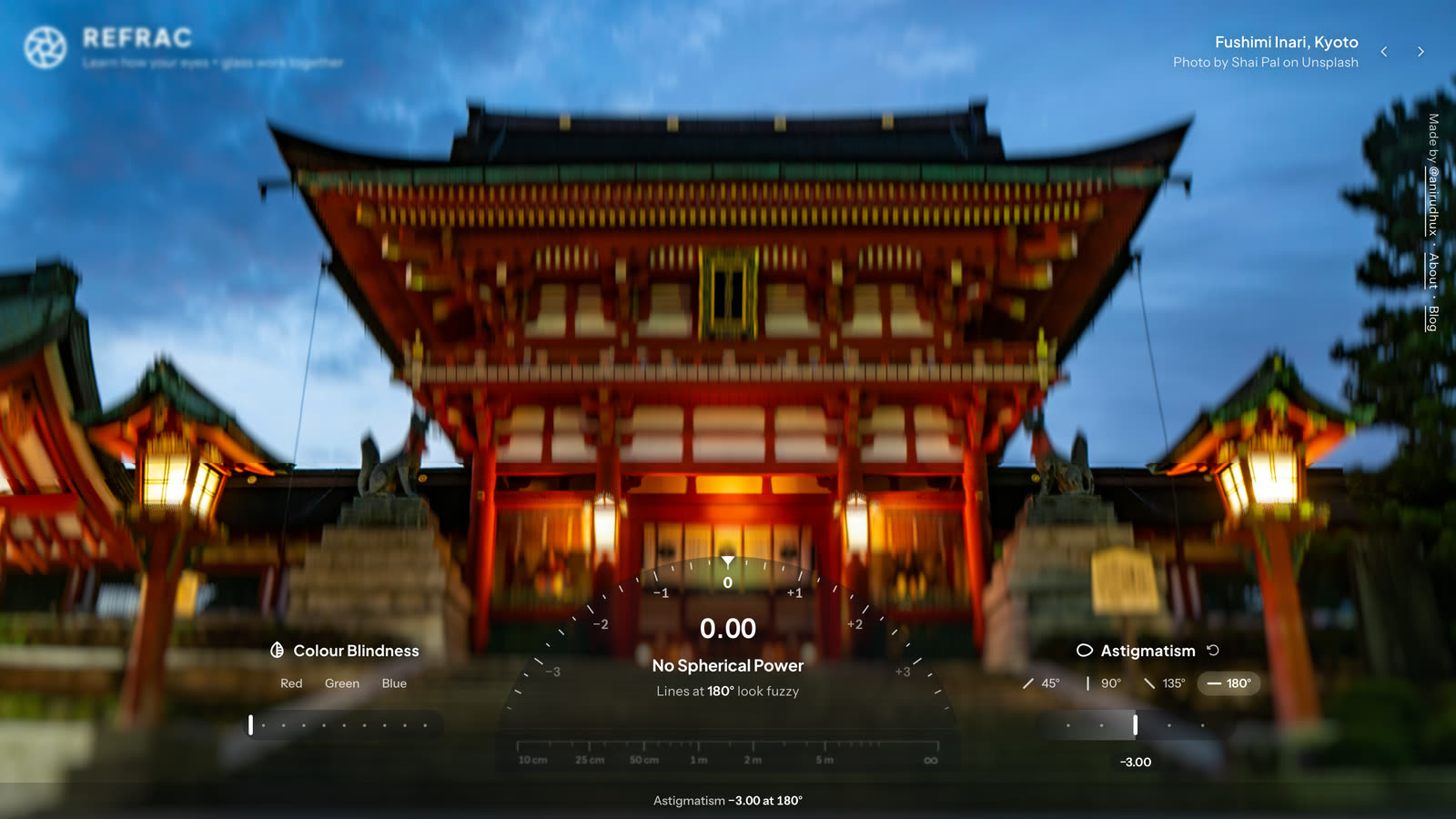
The axis goes from 1 to 180 degrees, measured round the eye like a protractor, where 180 lies flat and 90 stands upright. Cards write 180 rather than 0, since both describe the same line.
It marks the line along which the cylinder adds no power, and the cylinder works across that line. The lab uses it to rotate the lens in your frame, and a lens turned even a few degrees off its axis blurs again, more so the stronger your cylinder is.
Two cards can describe the same eye.
Optometrists usually write the cylinder as a minus number, while many ophthalmologists write it as a plus, so −1.00 −1.00 × 180 and −2.00 +1.00 × 90 are the same eye. To convert one into the other, add the cylinder to the sphere, flip the cylinder’s sign, and turn the axis by 90 degrees.
Your two eyes often mirror each other.
Astigmatism tends to run in mirror image across the face, so an axis of 80 in one eye and 100 in the other is common. If your two axes differ, that’s normal.
Try your own axis.
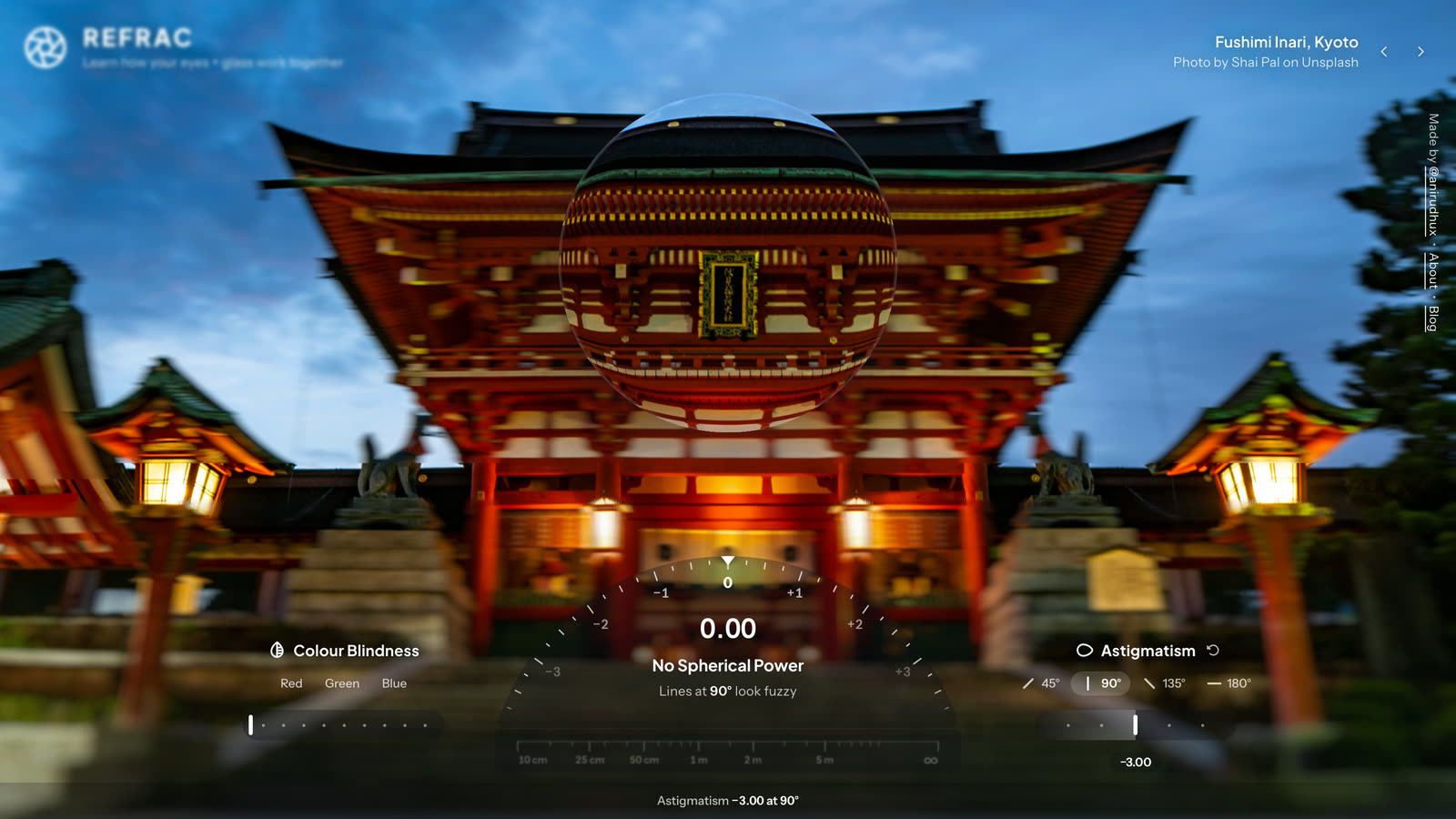
Open Refrac, set your sphere on the dial, then pick the axis nearest yours in the Astigmatism panel and slide to your cylinder. Watch which lines go soft, then drag the lens over them to bring them back.